The Hidden Price of "AI Everywhere"
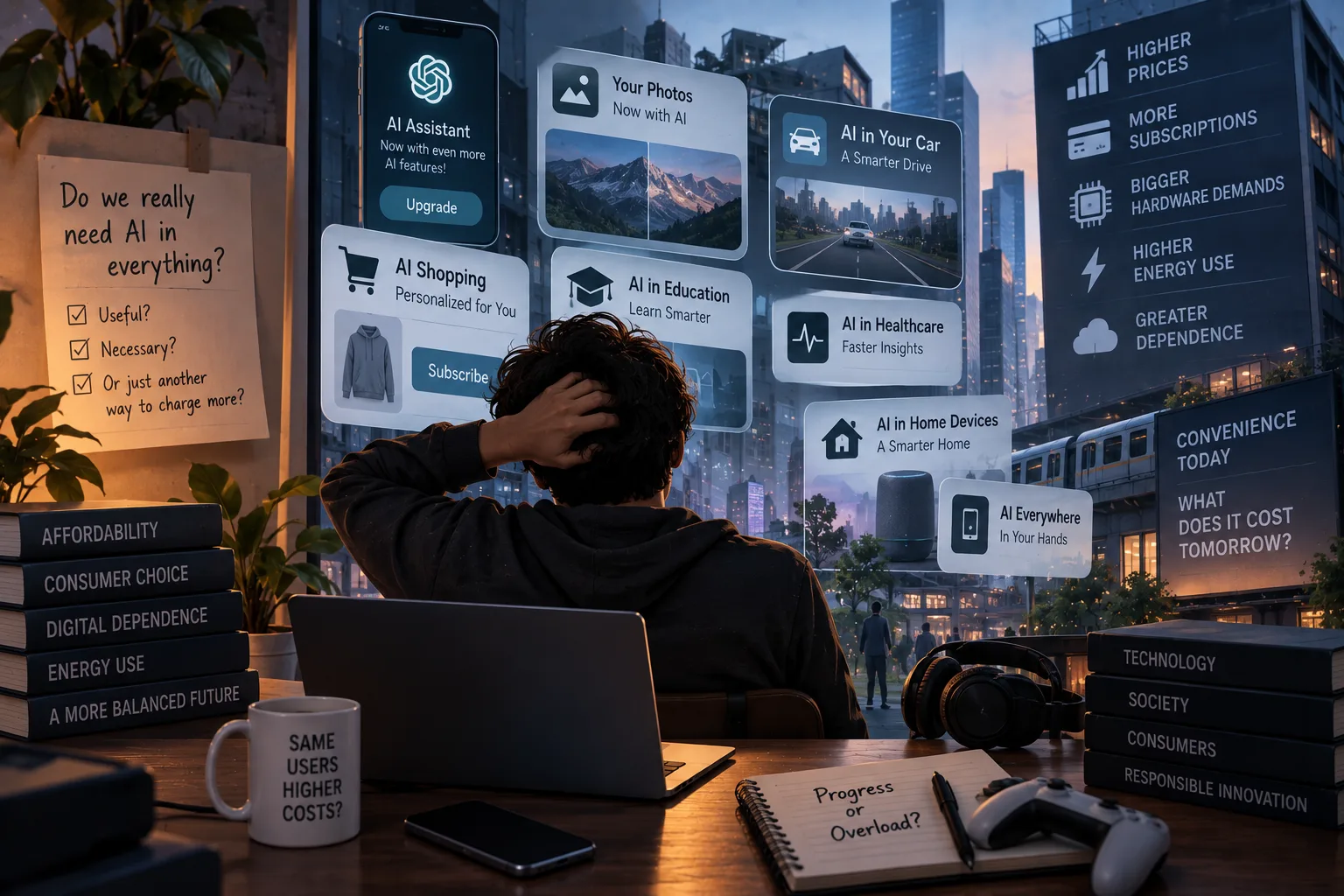
AI is being added to more everyday products and services, bringing higher prices, subscriptions, hardware demands, energy use, and greater cloud dependence. The article questions whether all of this AI is necessary and argues that progress should improve technology without reducing user choice.
The Hidden Price of “AI Everywhere”
By: Ali Abdullah
During the advent of AI, when the novelty of “artificial intelligence” still mesmerised the masses, many believed it was going to be a tool for improving their quality of life. Little did they know that it would turn out to be the cluttered, costly and confusing mess it has become. No doubt, the utility of AI is unquestionable; however, its sudden rise to popularity and demand has prompted different industries to try and integrate this newfound technological bonanza into their product and market it as a “feature”, whether it improves performance or not. Most people’s daily driver applications now have an AI feature. In fact, AI integration now shows up in almost all mainstream applications. Although one could just pass this off as corporations riding the AI hype train, this comes at the cost of not the corporations themselves but the consumers. Introducing AI increases costs. In order to mitigate these, subscription services have become the go-to option. The consumer is handed the short end of the stick in all cases, being forced to pick between paying the subscription, going through extra steps each time he wants to use the feature, or looking for an alternative app altogether. People are getting tired of being told “this is progress” when it feels to them like extra steps and another way to charge users money for things that they will never use. The biggest twist here is that this fatigue isn’t just about screens or software, but it’s about the material costs behind AI.
Even something as boring and simple as RAM prices can change the story dynamics of electronics. When a memory chip becomes more expensive, it doesn’t just affect “tech enthusiasts” or gamers. It shows up in the price tags of laptops, slower upgrades and devices that may start to feel outdated sooner than later. RAM is a memory chip that temporarily holds data your device is actively using so it can access it quickly. More RAM means more apps you can keep open at the same time. Higher prices for components raise the prices for the laptop and other devices, which then increases the cost of repair and that makes it harder for students, freelancers and small businesses. A student who only needs to do a Zoom call, write a doc and browse the internet has to pay the higher cost. RAM is just one piece; the bigger pressure comes from what AI needs to work at larger scale.
AI is presented as something that is smooth and weightless, as it’s said to be living in the cloud. However, in reality it is being run on data centres that use heavy sums of electricity and, to keep them cool, use a significant amount of water. This shows that when the local infrastructure grows slower than the footprint, ordinary people end up with the short end, with higher cost, a higher electricity bill and political fights over resources. Data centres aren’t located in remote areas; they are usually located in or near towns or cities using electricity from the local grids. People are asked to save water and electricity while the data centres can consume enormous amounts of energy. So the fatigue that people are feeling isn’t just psychological, it’s physical. People feel they are forced to pay for other people’s AI ambitions.
A lot of the backlash isn’t really against AI. AI isn’t the main cause of the backlash, it’s the AI-washing: companies slapping “AI-powered” onto products that do not even need it, i.e., AI thermal paste. It’s a paste that you apply on a CPU chip before you put on the cooler. It has nothing to do with AI as it’s not even an electronic; it’s a paste and yet it’s advertised with AI language anyways. Instead of simplifying life, these companies are making things confusing, more expensive, and harder to trust. Intel and AMD are launching new CPU chips and introducing new names for them and making the names longer and more confusing that, unless you have a tech expert with you, you wouldn’t know if the chip you bought is actually faster and more efficient or just a reshuffle of labels. When AI is forced into everything, even when people do not want it, with no option to disable it and when people actually try to use it, it is confidently wrong on things and people have to spend the time they saved by using it now to fact check, verify and correct; people start to see the cracks and stop using it. Hiding inside all of this, is a trend that’s being changed: ownership.
This phrase “You will own nothing and you will be happy” has been around for a while and recently Jeff Bezos and other tech leaders started openly talking about a future where people and companies will rent processing power instead of using their own machines, like how people use electricity or water utilities. This future may or may not come in reality but the way things are moving, does point towards that computing is going to fewer hands and inside massive servers and data centres. This means people will have to pay monthly or have to get into lock-in contracts with less offline options and people will have less control. People feel that they are paying for things that they used to own in the past and had more control over whether they wanted to upgrade or not. When they are relying on the massive companies, how much do they trust that these companies will keep their privacy secure? And what happens to their data if a data centre goes down, since everything is now “cloud first”. Putting these pieces together makes the picture clear of the public mood.
The sensible approach wouldn’t be to reject AI altogether. Rather it’s to demand change. To demand increased oversight by governments on where, how and when AI systems are to be deployed. Demand the option to opt-out of AI services, while still being able to access essential services. Moreover, to opt-in only when the artificial intelligence system has proven its utility, instead of forceful adoption. Demand transparency about the costs, not just financial, but in regard to all other matters which are often kept out of public eye. AI should be reducing friction in life, not adding to it! Ultimately, progress should feel like relief and not a burden which exhausts our attention, trust and wallets.